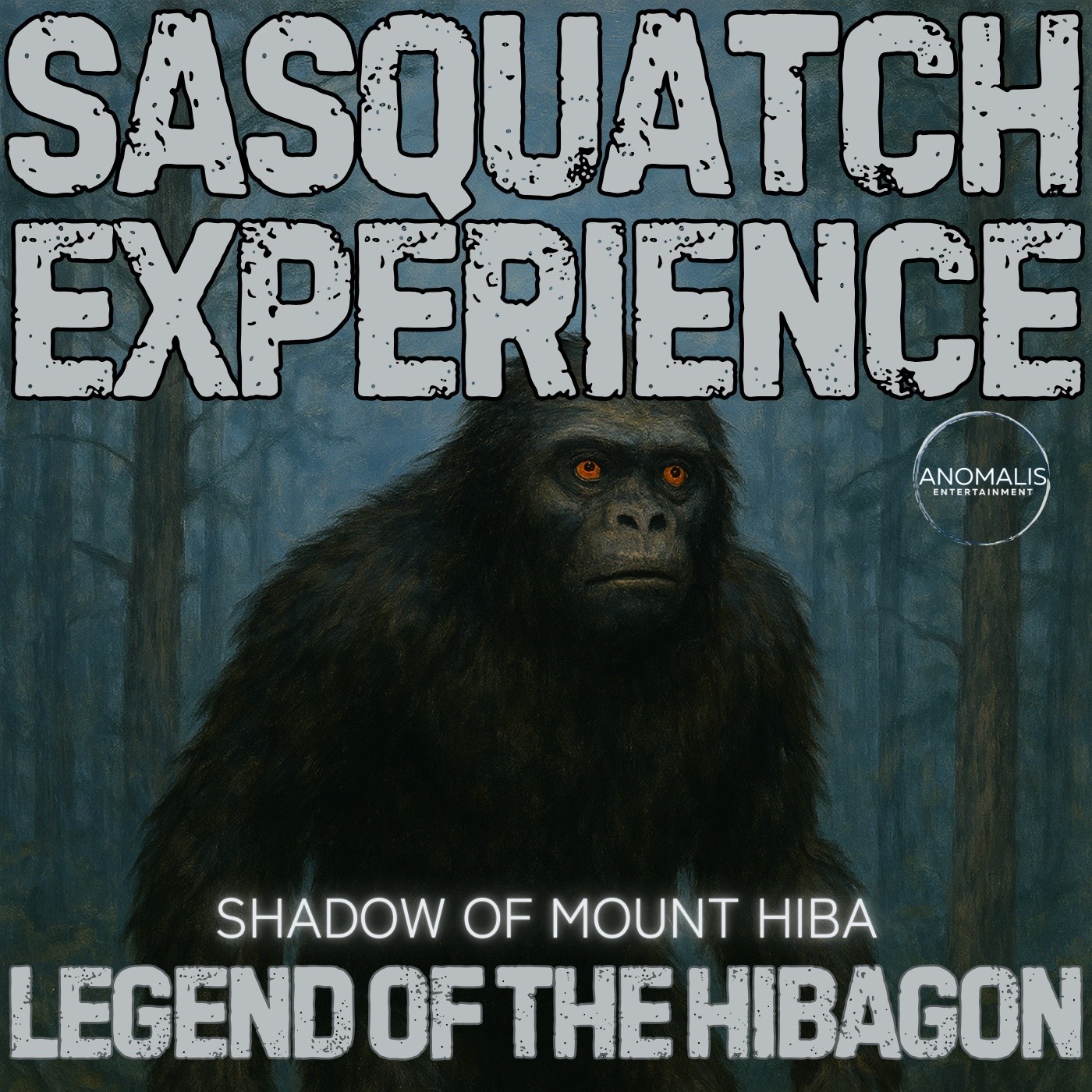
Shadow of Mount Hiba, Legend of the Hibagon
with The SE Crew · International Feature
PLEASE LIKE, SUBSCRIBE, RATE, AND REVIEW ON ALL PLATFORMS: YouTube, Facebook, Apple Podcasts, Spotify, Spreaker, or wherever you listen!
GET YOUR SASQUATCH EXPERIENCE GEAR FROM THE SQUATCH PRO STORE!
Sean Forker hosts SASQUATCH EXPERIENCE, which also features Matt Arner, James Baker, Vance Nesbitt, and Henry May.
Creative Consultants: Matt Knapp (Bigfoot Crossroads) & Les Sincavage (Xplorers: Seekers of the Truth).
Show Executive Producer: Brian Corbin
Special Thanks to all our Patreons:
The Experiencers: Jeffreylee Matthis, Got Knockers!, Larry Sharpe, Scott Dieterele, and Tom Mihok
Trackcasters: Cindy Brewer
The Hollers: Gail Frederick, David Hickernell, Matt Arner, Laurie Nelson, and Lori Worthington
Without their support, this show would not be possible. For as little as $2 per month, please consider becoming one of our supporters on PATREON.
Our show intro music, “It Comes At Night” by Adam Dib, is licensed to us for commercial use. “9-11 Bigfoot Call” is also used under Fair Use. Sean Forker and Gabriel Forker are credited with the intro and exit voiceover work. Sasquatch Experience Trailer music, “It's in the Fog” by Darren Curtis, is used with permission and attribution.
If you’d like to hear a particular topic or guest, EMAIL US!
Check us out:Facebook | X | Instagram | SasquatchExperience.com
- 0:04Welcome to Sasquatch Experience and the Japanese Bigfoot topic intro
- 3:07Allegheny Plateau Project update and winter field conditions
- 8:16Introducing the Hibagon of Hiroshima Prefecture and Mount Hiba
- 11:19Early 1970s Hibagon sightings: schoolchildren and roadside encounters
- 22:40Photo evidence, Mayaca ape comparisons, and regional ape theories
- 34:10Bergmann’s rule, Hiroshima Prefecture geography, and climate parallels
- 39:19Rokunahara Dam sighting, damage reports, and the silent-creature debate
- 45:27Official response, compensation for witnesses, and the 1974 photo case
- 48:34Yamagon reports, 2000s resurgence, and whether the creature survived
- 56:44Shinto folklore, yokai, and closing thoughts on the Hibagon legend
Views and opinions expressed by the guests that Sasquatch Experience do not necessarily reflect the opinion of the host, sponsors, or affiliates of the Sasquatch Experience. As always, listener discretion is advised. We got some one or something crawling around out your see what it was? Was it a person or an animal? Or I can't go. I know that my thunderway came on and I did that with a Glenn bad thing running across the yard, A goodbye man. The company looked by the man. I don't know what it was. Back in two thousand and five, we set out with one goal to give voice to the mystery and those who pursue it. Sasquatch Experience podcast has been your go to source for serious Bigfoot discussion, where we separate fact from folklore. Always grounded in research and respect. We've interviewed eyewitnesses, experts since skeptic like because understanding Bigfoot isn't just about belief, It's about the journey. Nearly two decades later, we're still chasing shadows and sharing stories. The search never stopped. Welcome to the Sasquatch Experience. Hello, hit somebody out here? Ed good evening everyone. Welcome to the Sasquatch Experience for Monday, January nineteenth, twenty twenty six. It's going to be weird saying that's still after a while, and guys, I tell you what, it's great to be here tonight. I'm going to do something a little different, going overseas to investigate well, the Japanese equivalent of Bigfoot, the He Begone, which is kind of exciting. The He Begone. James, Yeah, he was trying to do a whole Who's on first thing. He's been trying this all day, is what he's been doing. Vance will be joining us again here. Momentarily he was with us and apparently somehow we lost him. So we'll be back. But you know, we're going to take a trip to the Japanese prefecture of Hiroshima, where the creature known as the He Begone unsted fear, fascination and folklore. Is it a big a creature, something older, stranger, or something spiritual? I guess we'll find out as we go through this great topic. But again, folks, it's great for you to be here with us tonight. Myself, Henry May, Matt Arner, James Baker in the Flesh spent a great time since our last show. And I'll tell you what, colder than hell right now across our region. Even Henry said, it's like thirty five degrees down there in Mississippi, which to them is probably our equivalency of zero. Yes, so you know, good. Luck everybody warm up, and if you can't get warm, well that sucks. They had snow in Florida, they did. Yeah, how about that? That we know is when it's world end? Yes, Matt, what's new? You got any news for us on the front. You know, there's a couple things they're brewing, one of which I had this hypothesis and we were just talking about this this morning that generally between January and March we get some sort of sighting, some sort of encounter, some sort of track, something reported in an area of Pennsylvania that is not really squatchy at all, But between the air the months of January and March, we get these reports that that just kind of come in and it's literally right in my backyard. We just got one this morning, and I'm in the process of contacting the witness, and you know what, it again, it matches right up to what we were talking about and it kind of goes back to when we had my famillion on and some of the guys from the ARC that I think just again just the thought that the population in Sussex County, in that northern area, they may move down south, because inevitably every year last year we didn't get anything, but in years past, from I think like twenty sixteen on, there's always been something found. So again, whether it's footprints, localizations, class a. So again, this really kind of you know, gets the excitement for the investigations. Right, and I think it's it's great that you pointed that out because you have been a proponent for a while of that hypothesis of the you know, with the whole Allegheny plateau. Really and we're starting to see a lot of sightings start popping up in these areas. We're starting to investigate Matt, which means that people are paying attention and I think that they finally know where to get these sightings to because we've had more now in the last six to eight months than we've had in the past and persistently consistently now. The other thing too, I put down on my on my ex account with the Ling Plateau project. I'm not really on it that much, but I do occasionally post on air. I cam that, yes, that the roads right now in our research area where we like to go are beyond treacherous. They're all ice covered. Even even trucks, heavy trucks that have chains are still getting either stuck or spun out or going down the going down the side of the mountain Right now is not the time to be up there. But I think that the activity is probably still there. It's just that there's no witnesses up there. I mean there's absolutely on on like Montour Road, Ridge Road, those areas that that we've been that we've been hammering. There is not one person going out there. And especially when it's you know, when we're getting uh, you know, below freezing and uh daytime temperatures and and again the roads are just a solid sheet of ice. So we're treacherous, right, yes, yeah. So is there a go ahead donting season or anything that might be pushing the. Animal, Well, right now, there is a least season that ends, uh that ends very soon. This year they did allow for the least season for ri supposed to be used in certain areas. The only thing though, is not a lot of hunters are going up those areas, so a lot of them are keeping closer to the highways or they're being closer to parking lots, and they might hike in. Hiking is fine, but again, you know, Sean and Jeans, you know, I took both of you guys up up into that area. It would be quite a hike to go from you know, Route one twenty to you know, up where our research area was. Yeah. So yeah, it's something that you're really not gonna be able to do on foot. No. In fact, you know pretty much, I think until probably either the late winter or early spring, we're not really going to be able to get back to that spot at this point, right because it looks like at least for the next month and a half long term forecasts are going to be building that up with some more snow. Yes, so, and. I know you folks didn't tune in for a weather report, but I think it's you know, Matt and I you know, talking about these areas because you know, again the nice stress of folks. We are field investigators. We do spend time out there. This is what we do. Ye. So there you have it, folks, our Allegheny Plateau Project update. Uh, And I mean again, the sating reports are coming. iNTS. We'll have a lot more talk about uh through the weeks to come. So now we go back. We're doing something different tonight, guys. Uh. You know, we thought, what did we you know, want to cover here that we really haven't and we've done a lot in North America, but I thought it would be fun for us to take a trip over to Japan and talk about some of their cryptids, specifically, uh, you know, their version of the Bigfoot, which actually came to be watching War of the Gargantuas the other day. You know what, what did they have to have some sort of you know, creature over there that would be right? You know, they're they're quick valenci and of course you know they have all these stories of different yokai over there are these demon esque creatures and spirits, and you know, they are very spiritual people, the Japanese, and this how they weave these beings into their culture is very interesting. But the hibbagone is commonly cited in the Mount Heba area of the Herosima Prefecture, is described as having a black or reddish brown tint to its fur, being neither a dwarf nor a giant between five to eight feet tall, sometimes even up to nine feet tall, but having a repulsive smell or stink that one witness, you know, compared to septic a septic tank, and it never seems to make any sounds. So and all these encounters we're going to talk about, guys, and I sent you, guys all the information ahead of time. No noise is admitted from this creature in terms of a vocalization, which is kind of interesting because I think one of the things makes that different in comparative to ours is that distinct vocalizations in the whistling, right, and this isn't accompanied by any of that. Well, I would make a correlation to the fact that this was Hiroshima where the US had dropped the atomic bomb, and look what happened, and iguana turned into something called Gozilla. Well that was there, great, that was only in the American versione. Oh, don't take my fun away. Don't take my fun away. But I mean, so let's get into some of these sightings. Which is funny to me that witnesses began coming forward in the nineteen seventies, and there's contention over when the first sighting actually took place. So one source says that the first sighting happened in July ninth, with what appeared to be a man with bare skin and fur spotted between the Yuki and Minohara stations, which was reported in their newspaper on October twenty fifth. But the first sighting that I read of, and that's you know, even validated by Lauren Coleman, was a group of school children in the nineteen seventies that saw a hairy creature near their playground. Yes, they described. It as about five feet tall, covered in dark hair, with glowing eyes and a flat human like face. So this happened July twentieth, the first sighting. The contentious first sighting happened on July ninth, but two very different creatures if you go by the different sighting reports. I'm actually more tending to believe the kids, you know, a group of school kids, you know, could very well what they've seen been an ape of some sort. Right. We find the same kind of contrast and reports in the United States, where in one area you have a different description than you do in a different area. Yeah, but even though Japan is not as large as the United states, it does have different regions, and I think that's very plausible. Well, you make a good point with that, vance I guess the only part of the confusion that I don't want say confusion that makes it strange to me is that they're so close together. These sightings happen very regionally, and they're not spread that far out as opposed to you know, even in Pennsylvania these reports. You know, there could be hundreds of miles between some of these reports that happened. You're looking at something in a very you know, much more close proximity, right, right, And to have something so different as a bear skin and fur and then the other one completely hair covered, but did notice a human like face? That itself is kind of telling. But if you had never seen a chimpanzee before and saw person, would you beside it being covered in fur? Would you think would you not be able to mistake that for a little person if you didn't know any better? Yeah, Well, that's a good point, and I do appreciate Lauren Coleman did not interject any of his personal opinion. He just kind of posted exactly what was being reported. Right our job's dad context and asked questions and have the back and forth. Right, he just literally reported the news on that. But then here we go. July twentieth and nineteen seventy, around eight pm, Yoshi Taka Marisaki was returning home in his light truck when he saw a strange creature pass in front of his car as he crossed the Rocanara River and approached the Rokanara Dam. He was pronunciation, he was done, thank you. He described the creature as the size of a calf, too large to be considered a monkey. He took a relative who lived nearby to investigate the scene and found to overturn vegetation, but no footprints. So with this now he's adding more size and bulk, And I wish I could ask him what he means by the size of a calf as it was it quadrupedle? Was it standing up? Was what? What? In what context was that put in? Was it hunched over in quadrupedle? Was it standing up? Because that would make a big difference in terms of scale. Right, go ahead, bake. Because the only ape that's in Japan is the macaw, and they all weigh about nineteen twenty five pounds or. Like they're small monkey, right. But they wouldn't get that big. Now, it doesn't mean that it was something else, or it was you know, or it could be the Japanese traditions had a lot of spirits and animals and things like that. Because I was reading while we were talking about this, I was reading about it. In the forty three to forty five when the Americans got involved in the war, they were doing different things to animals and whatever, like painting them with a reflective reflective pain. Yeah, right, because the because the. Natural people would be startled enough to make noise so that they could shoot them, you know, yeah, because that's yeah. That's what it came down to. To your point, they had a lot of you know, they had a lot of traditions, and they had a lot of animals, absolutely right, you know, so some of these things that they saw, you might have seen something and they embellished some of them, and still there would be you know, at the time, and even now, I don't think there are any great apes in Japan, Like, especially with the way the world is now that you know, everything's everywhere, you know. I believe the United States has an ape population because of NASA, you know, and the circuses. Yeah, that's true. But to your point, James, the macaw in Japan has a human interaction with it. It's not that intimidated by people, whereas what we're talking about seems to be evasive to human population. There are no native true apes in Japan, right, but they do have the second largest captive chimpanzee populations in the world. So just something interesting to know if you talk about you know, they have natural disasters over there, you know, and we talk about things like earthquakes and bommies and is it possible they have typhoons? Is it possible something along those lines happened and some of these things got out. I don't think that's above the realm of possibility. No, not at all. And I think the same thing happens in this country too, oh, where there may very well be a natural disaster where some captivity was released and that is misinterpreted for what it is that we're looking for. Well, I've been writing the book and which will be coming out sooner than we think. And you know, one of the things is I'm writing my chapter on James Baker. And oh what is he a sasquatch? No, But one of the things I just talked about since I've known him back in the early two thousands, was that he's always believed, and I'm putting words in his mouth only because I've heard him talk about it so long that Sasquatch, if it exists, was probably a misplaced ape or misidentified ape. And I very much agree with James on that. Particularly in the skunk ape. James, You've always talked about, you know, where did the monkeys go from NASA? Where did they go when they get displaced in natural disasters? The circus even prior to that, though, even prior to that, when when settlers were coming here to do trade, they were bringing exotic creatures and wherever they landed on the shores of America, which some could be in Florida, and landed there, and let's say in orangutang or orangutang, however you want to pronounce it. Let's say it's you know, released, and it's adapted to the environment, and now it's known as a skunkpe. I'm not saying that's what it is, but you know, this has gone back through history for a millennia at least, or that these creatures have been brought. Here trade from South America, Africa, some of the other countries. They brought over animals too, like the horse was introduced to North America. My concept has always been that if you think about it, and I use Florida as an example because it's it's really a melting pot for not for a non native species. Mom, let's have a lizard in New York. It comes down to Florida. Mom, oh no, you're not having a snake in this house. Let's it go. It doesn't hang it out in the park. It goes it is because it's cold and moves towards warmer weather. Eventually they hit South Carolina, Georgia, Florida, Louisiana swamp lands is a perfect place. You know, you got the you got the the herpes monkey. You know. Box anytime he could mention that herpes monkey, he's pleased to do so. Yeah. But but to point to James's point, the same thing still happens today where you know, you have enthusiasts that will buy a python and then it starts getting too big and they're letting it go in the Everglades of Florida, and the next thing you know, you have an invasive species that's taking over and the same thing could have happened some years ago. You know, more people. Needed to watch movies from the eighties. Did they not see alligator? An alligator too? No, we did not. We watched Lake Placid with Betty White. Yeah. But actually though, you know, we make funnel Lake Placid. But they're actually finding that a lot of these alligators and swamp creatures are moving up north because the weather isn't as bad as it used to be, because they become what they call it keystone species, right, it changes. But on top of which, these creatures are able to survive freezing temperatures in the water. As long as there's snout is above water and they can keep inhaling air, they can survive freezing temper And it's proven in Florida all the time. You see these ice sheets over these ponds and there's alligators. They're not moving, they're not aggressive because they're kind of in a hyber native state, but they can survive it. And that's one of the key things. I was like this thing in Japan. Maybe maybe you know, and I'm not saying that every sighting has to be a monkey. That's not saying every sighting has to be a Sauce squad. Right, it's saying that the percentages are possible with what we can physically say we saw. Keep talking, James, Oh it was me. Oh God, we had we have we have? How many? We have? How many? Oh? Look at the pictures. We have so many undocumented creatures in the United States. But then you can prove some of them are there, but you can't prove the population. There was a and I wish I knew the name of the monkey. There was an eighth that lived in Jesus titties. Jesus, this is a family show. Okay, all right, Hey, he's the one busted them out. But anyway, so there's a there's an ape that they thought was beas Day and they found like five thousand of them in a deep African jungle because it took three to four days for someone to get into that and come back. So these animals, say, the Louisiana swamps. There's parts of Louisiana swamps. Nobody goes into. Hey, hey do you want me? You showed me the picture, right, So those were those. Images of the of the hebgone that we were able to find today in our research. And I put them together in a nice little presentation there. But you know what was interesting is that one picture that was taken kind of reminded me of the Mayaca ape from Florida. You know, we talked about that chimpish orangutan looking image that was taken from the you know, the Mayaca and Florida, that famous one that I you know, if anybody made that one famous, I really have to say it was Lauren Coleman who really showed that out. We know, we talk about Lauren quite a bit. I wasn't get Lauren on this show to talk about some of these things. But you know, you start getting several pictures of that and and you know, how do you start disputing it? And I know photographic evidence is always going to be of you know, interpretation, and I think screat right, But I you know, in the Mayaca photo has always been kind of strange because honestly, that one of anything has always reminded me of some sort of ape. Uh. And I've always felted to look a lot more real than fake. But when I started looking through some of the images of the habit of the hebagone, and I'm like, huh, you know, isn't that interesting? Uh? You know, because they do. They did to me look very similar even in the size. You know, what's interesting is that you're not necessarily talking about something that's like nine ten feet tall. You're talking about again, something within the five to six foot tall range. Really globally seems to be when you look at the orang pendec, when you look at some of the creatures that are seen in South America, they're all relatively that's you know, relatively that size. So could we be looking along with that point, Sean along with that point? Japan is part of the Asian continent, right random are yeah blacks sorry at water that's okay. Gigantopithecus blackie. You know those bone fractures were discovered in China. Okay, that's part of the Asian continent. That could put a very good correlation between a similar species, one larger, one smaller, kind of like in this you know, and I'll realm of this country too, where it seems those that are on the Pacific Northwest seem to be much larger than those in the Florida region, right. Well, as you get more of those tropical climates, you need to be more adapted to that environment. Matt I seem like you're ready to say somebody. Yeah, you know what, it goes right into this. I was looking and doing my research today at the comparison between the urine, the Chinese Bigfoot, and the Hibago, and really the only difference is the size, but most of the size they're saying, you know, maybe about six feet tall, but it could be up to ten. Again, the similarities in terms of the hair color, in terms of the facial features, in terms of the behavior, and not only that, but the urine is from central China, which would be almost not quite in line with Hiroshima, but it's going to put into a similar type of weather pattern and climate. I agree. I totally agree with that point of view, Matt, because I find so many similarities from the Asian continent to the US or North American continent. You know, the further south ego, the smaller they seem to be. The further north ego, the larger they seem to be. It's all I would assume that's all part of climate. But yeah, that's a really good point. There's a lot of similarities that are being attributed to both. But still, if I if I came across something six foot tall I would probably be just as freaked out as if I saw something ten feet tall. I don't think that's gonna make a whole lot of difference a. Tall day as much what you're saying, yes, yeah, no, do. You have Do you have more similarities? They found I I do have more similar east I found uh to compare with other areas. But we can see it. That was for after a break. Yes. In fact, right now is a good time to take that break, because we did almost the bottom of the hour. Can you believe it's gone that fast? Almost? You are listening to the Sasquatch Experience Sean Falker, James Baker, Matt Arner, Vance Nesbit, Henry may As we explore the legend of the hebagone and we'll be back right after the big football and horn bullhorn. Stay TUNEDOS team a symbol my life from Wisconsin. You think you guys get cold, go to Wisconsin. Holy smokes, he's up there. Thank you you cold. It was up there. That sucked. It was so cold in Wisconsin. The ice cream machine at McDonald's was working. Ah, yes, you know for the next month and a half. It is officially known as Frightened Turtle season if you know you know. And speaking of Wisconsin, here's an interesting story that I had a close tie to and might have to do something about it. A significant Bigfoot report involved Wisconsin teenagers in the Kettlemarine State Forest who witnessed a sasquatch approaching their campsite while they were shooting off bottle rockets, setting the entire state forest on fire and everyone died. Nah, I just made that part up. One of the teens left the campfire and went back to the truck to go get some more bottle rockets, and his eyes finally became adjusted to the night when he saw a very very large, upright figure with whitish black gray hair. Astounded by the shocking sight, the witness alerted his friend to the creature's presence, though he only caught a glimpse of its head and shoulders due to the darkness of the moment because the other teen's eyes was not adjusted. I find this interesting only because of the fact that some years back, Bigfoot researcher Jay Bachojan and myself went to the Kettle Moraine. Now Kettle Moraine is probably just a little over an hour away from Studio four oh one. Here it sits on the Illinois with Skans and Border, and oddly enough, at the entrance to Kettle Moraine is Bray Road, the Beast of Bray Road made popular by the late great Linda Godfrey. So there's an interesting point. Jay and myself pulled into a little maintenance clearing area at the Kettle Moraine where there was a trail, and we opened up our car door to get out because we took one vehicle, and the stench was just incredibly overwhelming, kind of smell like a pile of rotting meat with I don't know death. It was awful. But within just a moment or two later of making the acknowledgment of how badly it's stunk there, we heard, as the best eyes could describe to Jay, it sounded like a hundred pound bag of concrete mix hitting the ground about maybe twenty five yards into the woods. So we couldn't see anything, but we grabbed our gear out of the car and kind of went to where we thought we heard this noise. At didn't see anything, but there were rock clacking going on and a couple of other interesting things that happened on our adventures through the Kettle Moraine looking for footprints and any evidence we could find. So with that said, Kettle Moraine is a really cool place to go when we come back. Let's meet Forker in Forksville. You're listening to the big football horn right here on the Sasquatch experience. What's your take on bigfoot? I actually saw one in my backyard the other day. Did you It had taken down this deer. It was just ribbing its trying to eat it. It was just horrible. Wow, there was blood everywhere. Dog came out in the bigfoot bad way like he was nothing. This thing was tough. It was Harry. First I thought it was my wife. She wouldn't be tearing the antlers off the deer. No, should just go out there with the kneeggs and oh that's great. What's your take on do you think there is such a creature or. It's I think it could exist. I haven't seen one, but that doesn't mean it's not real. Well that's a great answer. Well, I love the fact that he's all on in your backyard. Hey, guess what, kids, it is the Yon the Footprints Tour by Mike Fameland. He is a bigfoot researcher and the producer of the documentary series In the Shadow of Big Red Eye. This is going to take place on Tuesday, February tenth, at five pm at the Forksville Inn. The address is five zero four to eight Pennsylvania Route eighty seven in Forksville, Pennsylvania. Join as Mike tells about his research and his experience. Thanks again for listening to this edition of The Big Football Horn, exclusively on Anomalous Entertainment's Sasquatch experience. And as always it is frightened turtle season. I'm tear we meet again in. The mid. Fright and turtle season. Indeed, Van says, if you know, yeah, very good. Well, as we were, uh, you know, hitting the brake, we had Matt getting ready to draw some more connections here, but I did want to acknowledge that, you know, Scott, one of our you know, frequent guests and supporters and friends, pointed out Bergman's rule, smaller species closer to the equator, bigger the further away, and that's kind of where we're talking about here with you know, these smaller, these smaller creatures seen in these in these tropical areas. So go ahead and their Matt continue on with what you were saying. So we were again in doing the research with this, I was looking at the area of Hiroshima, and Hiroshima is a large city as everyone knows, but the outside area is Hiroshima Prefecture, which is basically their rural area. Uh. It's almost like you have Philadelphia in all the areas outside. Well, maybe not Philly because it's kind of congested suburban suburban sprawl. So you might have like Pittsburgh and then you go, you know, uh, not that far an hour or two away to the Chestnut rich so in that prefecture. Uh. The comparison in terms of the way the mountains are, the climate, the way the houses are are put up in the little villages is almost exactly like eastern Tennessee the Smoky Mountains, right. So looking at some of the photos and I was just browsing some of the YouTube channels that talked about hiking through Mount Hibba, which is the where the hibbigone got the uh it got its name from. Uh, and a few of the other mountains up there. It's very similar in terms of going up to Klingman's Dome where uh, you know, going out to some of these peaks in the in the Smoky so uh so you do have and they describe the towns as being very similar to what we would have here in Pennsylvania, where you just have these old villages and then you have an expanse of uh of mountains. Then you have another village expansive mountains, another village expansion mountains. And when you think of Japan, you're thinking of Tokyo, You're thinking of these other uh major cities. But really outside of Hiroshima it again, even the climate is very similar to Tennessee mm which I think and again we know the Smokies and Cumberland Plateau are you know, both known spots in North Georgia, throughout the area North Carolina are all all have a lot of sightings, all have a lot of mountains. And again you're talking about a similar type of you know, environment where these creatures could live. And it is interesting that you bring that up because those areas that you brought up in the United States share the same latitude in Japan. Yes, so you know, size comparison would make a lot of sense to me. Yes, yes, And as our friend Scott just just put in a lot of the cities around the coast. But once you get to the interior. There's far more rural areas in Japan uh than even this area. This area it's considered suburban rural. But h but again, you know so is so is Gatlinburg and Pigeonforge. You know, so you're talking about a similar area. Yeah, that's a that's a good point. And thanks Scottford throwing that into the into the conversation. Yeah, well, I mean it's and he makes great points with it. You know, a lot of it is from the shipping and the transport and the you know, to bring goods into the into the countries, and as you know, you move out to the you know, more central you know, prairie esque kind of rural areas does make a difference, and you start seeing these these stories, particularly in Japan, start creeping up around the you know, the major metropolitan areas that kind of just I think Matt's comparison to Pittsburgh was very appropriate because you know, you really the Pittsburgh you go from city to not very quickly. Yeah, and you know thing here right, right, I mean, well it is the same way, right, you have these very rural areas that just kind of you know, come out of nowhere. But you know, we have another sighting that happened on the Rokunahara Dam on July twenty third, nineteen seventy, with a farmer mowing his grass. Now this is interesting, guys, because earlier when we were talking, this creature emits no sound. But mister Condo heard a roar and looked up to see a strange face emerging from the grass. He at first thought it was a monkey, so he tried to scare it away by making noises and swinging his sickle, but it did not run away. Stared at by the creature's large eyes, Condo became frightened and fled back to his home. Later, he returned to examine the site, and about a meter and a half of grass was found to have been knocked down. The creature was described as being tall as an average man, covered in black fur, and having a grotesque face with piercing intelligent eyes. Right, So interesting about this one is there is a sound that's admitted from it. Maybe he said or here he heard or world, but he didn't see it make the roar. Hmm, I don't know, right, Well, that's the great How many of these ahead advance? No, go ahead, Henry, No, I want to hear you, Henry, right. I wonder how many of these stories are lost in translation. As far as we're talking about something that legendly doesn't make sounds, we're talking about something that can range from five to eight foot tall, maybe nine feet. We're talking about something that is about the size of the Champanzee or bigger. Could this possibly be some sort of I don't know, it just kind of strange. Yeah, Well, you make a good point because these these cases weren't captured by US honkies, you know, they were taken by a local Japanese researcher. So I mean, it looks like the guy's name was Katsuyaki Ege, who was a town hall employee who collected the sightings. Now he's the one that took a lot of these, and of course Lorna Coleman, doing his research, you know, stumbled upon this gentleman and got more information. So I think we could you know, I understand what you're saying, but I think maybe we could take a little bit more credence in these because of you know, they are captured by someone local, someone knowing the nuance of the language. As I was learning pronunciations for today, I went online to learn how to say certain words right. And the funniest you know, Japanese often involves pitch being the differential between what the meaning of a word is. And you know that's that's nuanced, right, And so somebody who speaks that language and a native to that tongue getting these and translating them builds a little bit more confidence in me that at least it right, is not is not getting changed. But to your point, Henry, even though there's there's not a lot of variety in what we're seeing, there is a lot of variety what we're seeing. And it would seem to be that way. You know, I could also take the attribute to the fact that you know these creatures. Let's just assume these creatures are in existence. Uh, some may want to stay completely silent so that they're undetected, where others will you know, warn and growl and howl and make a lot of noise to keep themselves secluded. But but you know, that's the thing though, when we look at these reports, aside from that one notation of a roar, which the gentleman did not see it make a roar, this thing is virtually silent. It's not like our sasquatch, which is a noisy mother effort. You know, this one does his own thing and is pretty quiet. But you know, another sighting occurred on July thirtieth of the nineteen And what's really important is that these sightings happened like in the seventies through into the eighties, and then there's a little bit of a break and these things start happening again in the two thousands, right, Yeah, I saw that. It's like they come out of nowhere again in twenty twenty four. But you know again, one of the other ones that I call attention to here as a witness, was making his way to a sluice gate to fill the rice patties with water. He noticed someone walking along the path between the rice patties at about twenty meters away away from him. He guessed the figure was a female relative and called out to her to be careful, but she did not respond. When he looked into this person's face, he saw that it resembled a gorilla, so he fled the scene in surprise and fear got into his truck and drove to a relative's house. At the time the area where the creature appeared. I'm just trying to make sense of this, and several reports of damage to chestnut and cornfields were received. So it seems like once this gentleman started reporting this sighting, other people were reporting damage happening in their own fields. Sorry about that pause there, folks. I'll try to edit that out, Oh you will. I will edit that accurate. I mean it could be accurate. I mean, if you see a creature that's. It's got to eat, right. I know that we have the people that believe it's ethereal and blah blah blah blah blah, But I mean even there has to be a reason for it to be there. I mean, you look at any crypt, there's there's a core reason why it's there. Either that's where it laid the zor that's what Like even one of my favorite, the Maufman, the Moffman, had a core reason for the assessed. There's a core reason for it to be there and why and only was there for so long and why it kind of disappeared with the Bigfoot and with all the other crypt it's even you know, there's a core reason they showed up in that area. We just haven't figured out that one hundred percent. Well, you know, after these sightings started happening in the seventies, and in August of that year, the town actually appointed Katsuyaki Egy, a town office employee who was capturing these reports, to be in charge, and he opened a consul consultation service regarding the apes. This purpose was to prevent the press from coming to interview witnesses and disturbing the lives of the people. And the staff of the console Tation Service regarding apes conducted activities to respond to the universities, a research team and to the media and to obtain information from witnesses and paid them five thousand yen in compensation for their inconvenience. So they were paying the witnesses for the inconvenience of, you know, bothering them to get information to start putting it out there. Now, here's one that in August fifteenth, nineteen seventy four, Minora Mattani was driving with his mother along a prefectural road in near Shobara City when he noticed a monster in the middle of the road switching between a bipedal and quadrupedal form. He did snap a picture when the creature jumped onto a persimon tree. The creature tried to jump to a pine tree three meters away, but the branch broke and he fell. Stupid ape according to the witness, that was covered with gray silver hair, white around the neck, and had a red face. This creature measured approximately one and a half meters in height and eighty centimeters in girth. The photo was not well received and it's a poor quality. It's impossible judge from the photo alone. And I think in that little montage we had there, one of those, ye right, one of those photos was of that of the being. But at that time, noough, at that time that photo was taken, it was not with a digital you know, smartphone. There was probably done with a Kodak instamatic. Yeah, even though we're in the birthplace of technology, it wasn't it wasn't happening now, you know. Again, there were sightings that happened up until June of nineteen seventy five, where they dec issued the town issued a declaration of the end of the Hebigone case. Okay, right, so what do you think about that, guys? No? Well, interesting though, and they think that the he begun may have died because a large, unidentified skeletonized carcass of a creature was found in the mountains near Mount Heba in nineteen eighty. Yeah, well until a he began jumped on a cargo chip from Japan to America. And then the next thing we know, we have another cryptid to try to figure out. Well, and then sightings of another creature called the yumigon was seen in Yamano Town in the nineteen eighties, and that started its own flap that started October twentieth and the nineteen eighties. It was a long black. Train coming down the line. Okay, you know it takes ten seconds to hit your mute button. I don't understand one hour of fucking week. Okay, oh that's so. And again now in October nineteen eighty, this all starts up with a creature observed to be one and a half meters tall, gorilla like muscular body with grayish brown fur covering its hair except the belly. This we'll call this one bear belly. The witness observed this for approximately one minute. The monster assumed a quadrupedal posture, walk down the bank, cross the river, and disappeared through the trees like a monkey. So now we start seeing another creature of similar proportions. Yeah, but I have to interject that one meter tall is really not that big. No, And we know a number of primates that do not have hair on the belly. Well, yeah, a meter and a half you're talking about, what, that's three and a half feet tall at best. Well now, I think a meter and a half would be about four or five feet tall, okay. Either, right, even with no hair on the belly. That's that's kind of common with common primates as of today. I mean, if I was wearing shoes, it could be confused with me. So about high heels. Heels? Oh stop its. In nineteen eighty one, a thirty centimeters wide footprint was found on the county road in front of the health center in Yamano Town. Is considered one of the earlier Yamagan cases. Which is funny because just like this, damn the Yamagon, just like the Hibigon, there's contention over whether when the first sighting happened. Again, just craziness. And then now we start going back to the Riwa era. It's like they name these areas after you know, the same Godzilla. You know it's all about I know, there's a real reason behind it. Henry got offended. Sorry, Henry, Yeah, trying to get the gotcha. He hit his mute button. There see, Henry got the message, and two thousand and four, settings of a large ape l like creature began again in Shabar's city. Five sightings happened between twenty twenty four in June of twenty twenty five, oftentimes happening in the summer or our summer. It's pretty interesting and again, you know. In August twenty twenty four, an older man opened his front door and saw black creature in a field twenty three meters away. Thinking it was a monkey, he called out to it. The beast then leapt over a two foot high electric fence and fled a two foot high electric fence. I could jump over that. Yeah, pretty sure this. Is this Henry was talking about those translation things before. I'm pretty sure that was meant to be two meters but interesting enough, though, two Italian tomatoes were left behind at the scene, so it could have. Been a Mario brother. Okay. Wow. In September of that year, a farmer spotted would appear to be an elderly woman. Upon approaching, he claimed it was a giant monkey because I make that mistake a lot, and actually. One time I was driving down my alley stop it. Yeah. So again, a lot of anecdotal reports after this, none of them has detailed as some of the earlier sightings we got. I don't know, guys, what do you think did this creature die? Do you think it was this creature that died? You think there's I don't know that it died. Ya'm a god still around. Yeah, I'm not sure that it died. It's probably just adjusting to its environment and making itself a little bit more discreet to any human reaction or human interaction. But I wouldn't say between the seven these and now that it would have gone extinct. It would matter if it's like a one and done creature, like in other words, like something got off a boat or something got off us some kind of caravan or something like that and was in Japan, that I could see where it would be dad per se. But if it's a cryptid species, as we're trying to assess, then there would have to be some kind of tribe or someone kind of heard, you know. It couldn't just kill one and then'd be it. So it's either a it's either a not. It's either a creature that someone dropped off somewhere, you know, by accent or purpose. Hey, this would be funny. Let's put a great ape in the village of Bin that was for them, you know. And then, because like I said, is in I know, it's in the forties and the fifties, in the time of World War Two, the American the American troops were doing all kinds of crazy things to mess up the Japanese, you know, to throw them off their game. Right, if it's a one and done, that could be believable. But if not, then there has to be more than one. I mean, that's like I always believe that if NeSSI exists, either it's immortal or there's a nesty pod. We just never fall right. And the same theory can be applied to you know, Vietnam with the rock apes. You know, here's all this chaos going on, but yet these troops are experiencing the rock apes. I'm not sure that they would have just dissipated and become extinct. Right, go ahead, Henry, you were going to say, it would have to be a viable population, otherwise it would go extinct a long time ago. Good point, right, The other. Yeah. One thing I was gonna say is, Okay, we're talking about the nineteen seventies, in the nineteen thirties and the forties, Japan had actually invaded China. And there's that one unit I forget what like Unit six or six that's like super super bad to look up. Don't look up there anyways. But they they were doing all sorts of crazy things over there. And how do we know that they didn't bring a yearine over to overtweenland Japan. Right or just regular apes mm hmm, yeah, with this with the same intent of turning them into super soldiers. Yeah, who knows. Like Russia or or the odd question of the. Some of the islands outside of the outskirts of Japan they found people in the fifties and the sixties that didn't realize the war was over. And we're looking in the woods like hermits and you know nomads. I mean, well, and you can you know when you go back to that report of a guy of it looked like a bear skin creature wearing fur. That could be a person. Oh sure it could yep. I mean, do they have other bears in Japan? They do have bear they they do have bears like brown bears are uncommon in that area, but they still have been sighted in that area. Yeah, you know, Matt, I'm trying to as fast as I can come up with a name for the bears of Japan, but yeah, they do have a specific bear there. The bad news this style Chicago, I. Tell you we can't ever win. I do want to say we try. I do want to say this was a fun discussion the night, something a little different out of our realm. Yeah, we didn't even talk about the spiritual aspect of you know, the Japanese connecting this to the Yokai and you know what this could mean from a I don't want to say paranormal but a folk lurish kind of, you know kind of way. Was it a mass psychogenic event? I doubt it, but you know, the Japanese and I have a note here that says, in Shinto belief, forest or sacred places home to spirits. The idea of a forest dwelling humanoid isn't just plausible, it's part of the cultural fabric. And so perhaps folks seeing something like this that's akin to them probably more along the line of encountering a potentially an angel or a demon or a spirit as we would encounter them in our homes. This is you know they you know, they're more adept to I don't say adept they're just more open to. That the theology. Right. Thanks you filled up my sentence there. I appreciate that. No, No, I try the best that I there to wrap that up. Good job, thank you. Van's earned his paycheck tonight, folks. Hey two dollars. That's right, we make an ad revenant. No, I'm just kidding anyhow, good show tonight, lots of fun. We have more coming up down the pipeline. Next week I will be a guest on Where's My Stage with Mike Ann and Christy, so I'll be joining them at eight pm on the twenty ninth. I'll also be out of town, so I'll be doing that one on the road, and then in two weeks we'll be back with another episode of Sasquatch Experience. And keep checking the Patreon, which you can join for as little as two dollars a month to help keep the wheels going on the bus. Here We've got some great stuff coming down the way. Henry's Bigfoot Trivia. By the way, only person on the board so far has been Steve Coles only one answering the question correctly. For the question from week one of who was the newspaper writer who wrote the first story on the Patterson Gimlin film, Henry, the answer is al Tostado, right, But then there's also some contention. Steve wrote as because because the byeline I guess was never credited to al Tostado, it was just gathered that his writings were very similar in style. But we will accept al Tostado as the answer, and so far Steve calls the only one on the board with points. This week's question who got footage of a possible white bigfoot in Ohio in nineteen ninety two? And don't answer that, folks, because that questions still live and those answers will be gathered, populated and we'll pick a winner of our first prize. I know the answer, and do I get Girl Scout cookies? Or no? No, no, you don't know. You can't answer, vanc it's a conflict of interest. But folks, Henry, go ahead and take us out with those dulce dulcet tones. Y'all be good, It'll be good at it. We'll see you next time. Folks, keep on squatching. You've been listening to The Sasquatch Experience. Please rate and review wherever this podcast is consumed. For more information, please go to our website, Sasquatch Experience dot com. Keep on Squatching,
Transcript is auto-generated and may contain minor errors.
Bigfoot on Video Part 5
Jay Bachochin